Acne vulgaris is among the most common dermatologic conditions worldwide and frequently results in permanent scarring. These scars can persist long after active acne resolves, leading to significant cosmetic concerns and measurable psychological distress. Facial acne scarring occurs in up to 95% of patients with moderate to severe acne and represents one of the most challenging conditions in aesthetic dermatology and facial plastic surgery.
Multiple procedural modalities exist for treating acne scars, but two of the most widely used technologies are microneedling and fractional carbon dioxide (CO₂) laser resurfacing. Both treatments aim to stimulate dermal remodeling and collagen production, thereby improving scar texture and appearance. However, they differ substantially in mechanism of action, depth of tissue penetration, efficacy, downtime, safety profile, and patient selection.
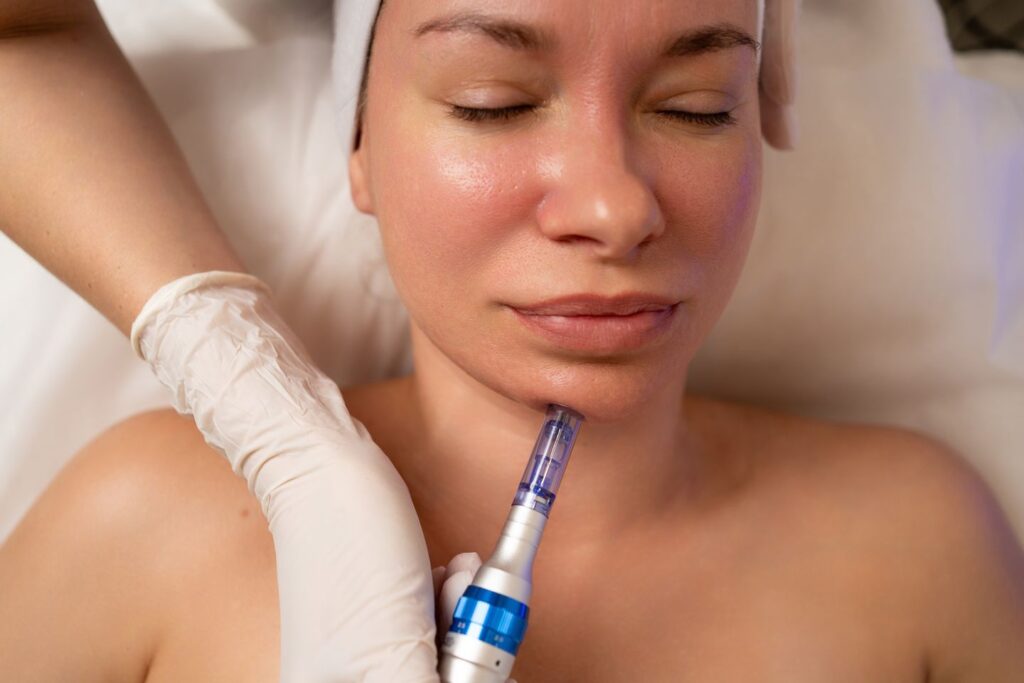
Microneedling—also known as percutaneous collagen induction therapy—is a minimally invasive procedure that creates controlled micro-injuries within the dermis using arrays of sterile needles. The resulting wound-healing cascade stimulates neocollagenesis and elastin formation.
Fractional CO₂ laser resurfacing, by contrast, uses a high-energy laser to vaporize microscopic columns of tissue within the skin. This ablative process removes damaged tissue and induces a robust remodeling response through controlled thermal injury.
Understanding the differences between these two approaches is essential for clinicians and patients when selecting the most appropriate treatment strategy for acne scarring.
Pathophysiology of Acne Scarring
Acne scars develop because of inflammation within the pilosebaceous unit. When inflammatory acne lesions rupture the follicular wall, dermal tissue is damaged. During healing, abnormal collagen deposition and tissue loss may occur.
There are three primary types of atrophic acne scars: ice pick scars, boxcar scars, and rolling scars.
- Ice pick scars are narrow, deep scars that extend vertically into the dermis. They resemble small puncture wounds and are often less responsive to resurfacing procedures because of their depth.
- Boxcar scars are broader depressions with sharply defined edges. They may be shallow or deep and often respond well to resurfacing treatments.
- Rolling scars produce a wave-like skin texture caused by fibrous bands tethering the dermis to deeper tissue layers.
Microneedling
Microneedling involves the use of a device equipped with multiple fine needles that penetrate the skin to a controlled depth. Devices may be manual rollers, automated pens, or radiofrequency-assisted systems.
The procedure works through controlled dermal injury without epidermal removal. The needles create microchannels within the skin that trigger the wound-healing cascade. Platelets release growth factors, fibroblasts proliferate, and new collagen is deposited during the remodeling phase. This process gradually thickens the dermis and improves scar depressions.
Procedure Technique
Microneedling treatments typically involve topical anesthesia, antiseptic skin preparation, multiple device passes across the skin, and post-treatment application of soothing serums or growth factors. Needle depths typically range from 0.5 mm to 2.5 mm depending on scar severity.
Clinical Effectiveness
Clinical studies demonstrate improvement in acne scars following microneedling treatments. Most patients experience 30–60% improvement after three to six treatments. Results develop gradually as collagen remodeling progresses over several months.
Advantages of Microneedling
Microneedling offers several advantages including minimal downtime, a strong safety profile in darker skin types, lower cost compared with laser procedures, and compatibility with adjunctive therapies such as platelet-rich plasma and topical growth factors.
Limitations of Microneedling
Despite its benefits, microneedling typically requires multiple treatment sessions and may provide modest improvement in severe acne scarring. Deep scars may require additional procedures such as subcision or laser resurfacing.
Fractional CO₂ Laser Resurfacing
Fractional CO₂ lasers emit light at a wavelength of 10,600 nm that is strongly absorbed by water within skin tissue. This energy vaporizes microscopic columns of tissue known as microthermal treatment zones.
Each laser pulse produces ablation of tissue within the column along with surrounding thermal coagulation. The untreated skin between these zones allows rapid healing while stimulating significant collagen remodeling.
Clinical Effectiveness
Fractional CO₂ lasers are widely considered one of the most effective treatments for acne scarring. Studies often report 50–80% improvement after one to three treatments. The ablative nature of the laser allows deeper dermal remodeling compared with microneedling.
Advantages of CO₂ Laser
CO₂ laser resurfacing provides greater efficacy for moderate to severe scars, requires fewer treatment sessions, and improves overall skin texture, tone, and fine wrinkles in addition to acne scars.
Limitations of CO₂ Laser
CO₂ laser resurfacing requires significant recovery time. Patients typically experience redness, swelling, and peeling for 7–14 days. The procedure also carries a higher cost and a greater risk of post-inflammatory hyperpigmentation, particularly in darker skin types.
Comparison Between Microneedling and CO₂ Laser
Microneedling induces collagen production through mechanical micro-injury, while CO₂ laser resurfacing uses ablative thermal injury to remodel skin. Microneedling generally requires more treatment sessions but has minimal downtime. CO₂ laser treatment often produces more dramatic results but involves longer recovery.
Patient Selection
Microneedling is ideal for mild to moderate acne scarring, patients seeking minimal downtime, and individuals with darker skin types.
CO₂ laser resurfacing is more appropriate for moderate to severe scarring, patients seeking faster and more dramatic improvement, and individuals who can tolerate longer recovery periods.
Combination Treatments
Increasingly, clinicians combine treatments such as subcision, microneedling, platelet-rich plasma, and fractional laser therapy to address multiple aspects of acne scarring. Combination approaches often produce superior outcomes compared with single-modality treatments.
Safety Considerations
Both procedures are generally safe when performed by experienced providers. Microneedling complications are rare and typically limited to temporary redness or swelling. CO₂ laser resurfacing carries additional risks including infection, prolonged redness, and pigmentation changes.
Post-Treatment Care
After microneedling, patients should avoid makeup for 24 hours, use gentle moisturizers, and apply sunscreen regularly.
After CO₂ laser resurfacing, more intensive wound care is required, including frequent moisturizing, gentle cleansing, and strict sun protection.
Conclusion
Microneedling and fractional CO₂ laser resurfacing are two effective treatment options for facial acne scarring. Microneedling offers a minimally invasive approach with minimal downtime, while CO₂ laser resurfacing provides deeper remodeling and often greater improvement in severe scars. The choice between treatments should be individualized based on scar type, skin type, patient goals, and tolerance for downtime.